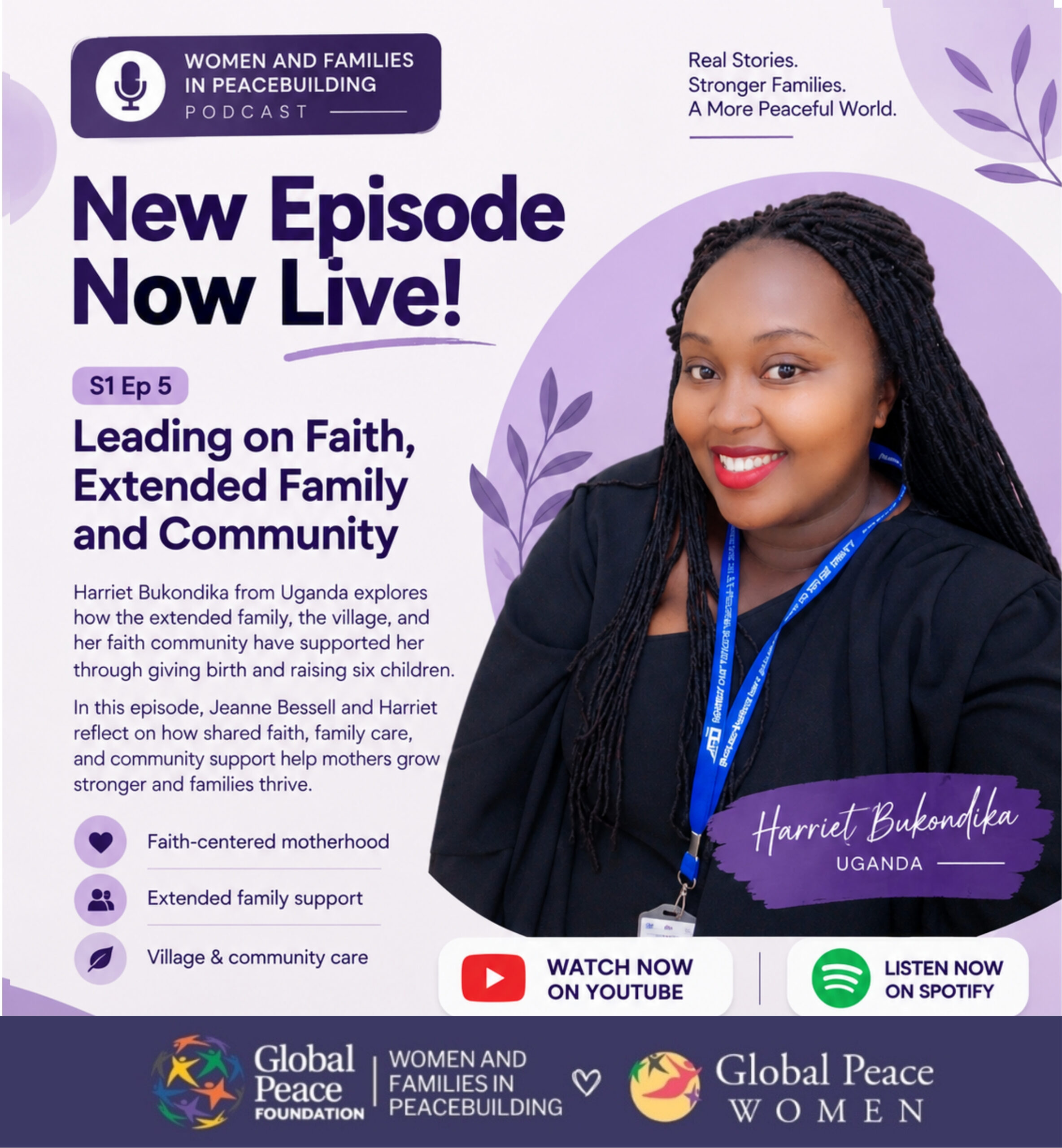
In Season 1, Episode 5 of Women and Families in Peacebuilding, host Jeanne Bessell speaks with Harriet Bukondika from Uganda about motherhood, tradition, faith, and the community support that helps families thrive.
There is a quiet kind of strength in a mother’s story.
It is not always found in grand speeches or perfect moments. Sometimes it is found in the hands of a mother or auntie preparing food for a woman close to giving birth. Sometimes it is found in a sister washing clothes while a new mother regains her strength. Sometimes it is found in a neighbor who cares enough to correct a child, not out of judgment, but out of love.
For Harriet Bukondika, a mother of six from Uganda, motherhood has never been a journey walked alone. It has been held by faith, guided by tradition, and strengthened by the extended family and community around her.
In S1E5: “Leading on Faith, Extended Family and Community,” Harriet reflects on the support systems that have shaped her experience of giving birth and raising children. Her story is rooted in Ugandan family life, especially the tradition of surrounding new mothers with practical care, wisdom, and encouragement.
When a woman is preparing to give birth, Harriet shares how she may go to stay with her mother or an auntie. There, she is cared for in ways that are tender and practical. She is helped with meals, comforted through physical care such as massage, and taught the small but essential skills that every new mother needs.
These lessons matter. A first-time mother may not yet know how to clean a baby’s umbilical cord, how to handle the early days of newborn care, or how to manage the physical and emotional demands that come after childbirth. In Harriet’s community, she does not have to learn all of this alone. The women before her pass down what they know. They help her gain confidence. They remind her that motherhood is not a test she must pass by herself.
As a mother becomes more experienced, the kind of support may change, but it does not disappear. By the third child and beyond, Harriet explains, the help may come from friends, sisters, or women close to the family. They may come into the home to assist with housework, washing, and daily responsibilities so the mother can recover, care for the baby, and continue leading her family with strength.
This is the beauty of a living support system. It adjusts. It understands. It shows up where the need is.
At the heart of Harriet’s story is faith. She speaks of faith as total reliance on God and of spirituality as a deep connection with the divine. For her, children are gifts from God, and raising them is not only a responsibility, but a sacred trust. Motherhood, in this sense, is more than caring for a child’s body. It is also about shaping the heart, guiding character, and raising children with values that will carry them into adulthood.
Her words remind us that faith can be a shelter for mothers. It gives courage when the days are long. It gives patience when the work feels endless. It gives meaning to the ordinary routines of parenting the feeding, teaching, correcting, comforting, and praying that happen day after day.
But Harriet’s story does not stop with family and faith. It also brings the wider community into view.
In the community she describes, children belong not only to their parents, but to the village. Neighbors take interest in how children behave. If a child is doing something wrong, adults nearby do not simply look away. They correct, guide, and help shape the child’s morals and character. This is not interference. It is a shared responsibility.
That idea feels especially powerful today.
Many parents around the world are raising children under pressure, often with little help and even less rest. Modern life can make families feel isolated, as if every burden must be carried privately behind closed doors. Harriet’s story offers a warmer and wiser picture. It reminds us that children grow best when they are surrounded by people who care, and mothers are stronger when they know someone is standing beside them.
This is also where peace begins.
Peace begins in homes where children feel loved. It begins in families where mothers are supported. It begins in communities where people do not ignore one another’s struggles. It begins when a child learns that correction can come with care, that faith can guide daily life, and that family is larger than one household.
Harriet’s journey as a mother of six is personal, but its message reaches far beyond one country or culture. Every mother needs encouragement. Every child needs belonging. Every family needs people who will help carry the weight when life becomes heavy.
Her story is a reminder that the village is not an old idea. It is a necessary one.
When extended families, neighbors, and faith communities come together, they do more than support mothers. They help raise children with roots, values, confidence, and compassion. They help build families that can endure. And from those families, stronger communities can grow.
S1E5: “Leading on Faith, Extended Family and Community” is a moving conversation about motherhood, faith, tradition, and the quiet power of people who choose to care.
Because no mother should have to lead alone.
No child should grow without a circle of love.
And when families are surrounded by faith, care, and community, children do more than grow.
They flourish.
Watch the full episode on YouTube: link