Peacebuilding often begins in the quietest places around family tables, in classrooms, and in everyday conversations between generations. Long before young people enter public life, they are shaped by the values, relationships, and examples they experience at home.
“Family is the heart of peacebuilding.”
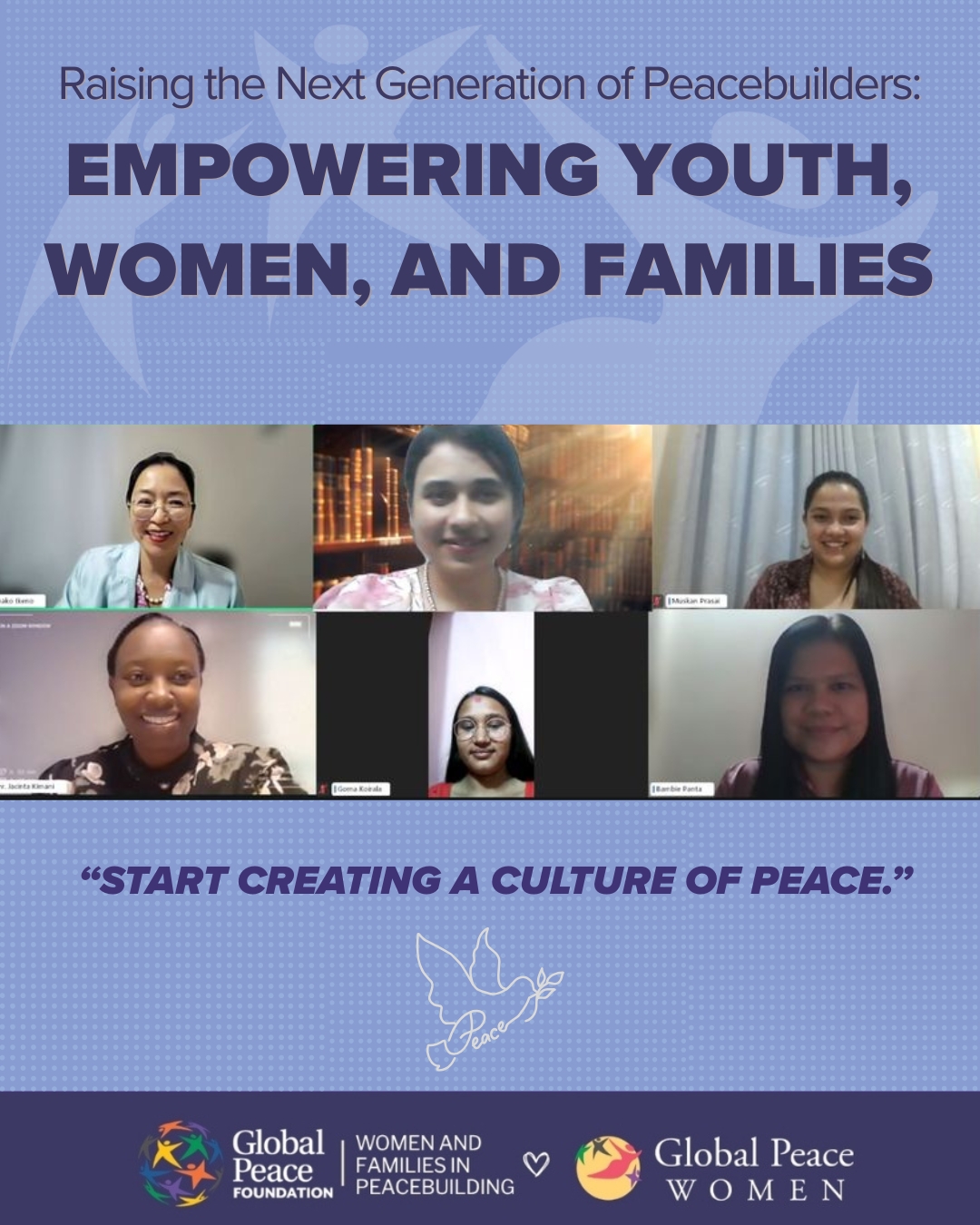
This participant reflection captured the spirit of Global Peace Women’s webinar, “Raising the Next Generation of Peacebuilders: Empowering Youth, Women, and Families,” held on Saturday, August 8, 2026, at 1 PM UTC. The webinar brought together parents, educators, faith leaders, youth leaders, women leaders, and community partners from 28 countries for a meaningful conversation on youth leadership development from a family-based perspective.
The discussion addressed how families, women, and young people can work together to build a culture of peace. It emphasized that youth leadership does not begin only in public platforms, schools, or organizations. It begins in the home, where young people first learn responsibility, empathy, communication, service, and respect for others.
At a time when many families are navigating rapid social change, digital pressures, mental health concerns, and widening generational gaps, the webinar offered a timely reminder: peace begins with the relationships closest to us.
The session opened with a simple but powerful prompt: “Peace begins with ______.” Participants were invited to reflect on where peace begins in their own homes, relationships, and communities. This opening reflection set a personal tone for the discussion and reminded everyone that peacebuilding is not only a global mission. It is also a daily practice shaped by how people listen, guide, support, forgive, and build trust with one another.
As shared during the webinar, “Peace does not begin only at negotiation tables. It begins in homes, in families, in classrooms, and in communities where young people learn compassion, courage, respect, and responsibility.” This message became the foundation of the conversation. It encouraged participants to think about how the next generation learns peace not as an abstract ideal, but through lived experience, family care, discipline, emotional support, and community examples.
In her welcome message, Ms. Hanako Ikeno, President of Global Peace Women International, grounded the webinar in the mission of Women and Families in Peacebuilding. Her message affirmed that families are not separate from peacebuilding; they are one of its most essential foundations. When children are listened to, guided with care, and taught responsibility at home, they are better prepared to practice peace in their schools, communities, and future leadership.
The keynote session featured Rev. Jacinta Kimani, Marriage and Family Therapist, ordained minister, Certified Positive Discipline Educator, and National Coordinator for Family Ministry at Scripture Union Kenya. Her keynote centered on a powerful message: “No Home; No Peace.”
Rev. Jacinta reflected that the home is the first training ground where children learn the morals, values, relationships, and responsibilities that shape who they become. When family bonding and connection are weakened, the impact reaches far beyond the household, affecting communities, development, and peace.
Her message was both practical and urgent: peaceful communities begin with children who are guided with both care and responsibility. Raising peacebuilders requires more than good intentions. It requires patience, strong relationships, and intentional family environments where children can grow with love, accountability, and purpose. Her reflection also highlighted the important role of parents, caregivers, and women in nurturing homes where peace can be practiced before it is preached.
The webinar also featured Muskan Prasai, M.A., Clinical Psychologist, Individual Counselor, Student Mentor, and Workplace Mental Health Practitioner. Muskan brought attention to the emotional and mental well-being of young people and families through a deeply human reflection:
“Every parent wants their child to be happy. Every child wants their parent to be at peace. That mutual desire is the ground we build on.”
Her message highlighted the emotional bridge between parents and children. Peacebuilding within families begins with listening, understanding, emotional support, and safe relationships. When parents and children recognize their shared hopes for one another, they can begin to build trust, resilience, and healthier communication.
Muskan encouraged participants to see peace not only as the absence of conflict, but as the presence of care, trust, emotional safety, and mutual respect within families and communities. This reminder was especially relevant for families supporting young people through social pressure, digital influence, and emotional challenges.
Participant reflections showed that the conversation moved beyond theory. Many left with practical commitments: to build peace at home, strengthen parent-child relationships, guide children with healthy boundaries, support young people through digital pressures, and promote healthier family unity within their communities.
One participant committed to “start creating a culture of peace.” Others reflected on the need to raise awareness through writing, teaching, public speaking, civic participation, and youth engagement. These responses showed that participants did not simply attend the webinar; they began thinking about how to carry its message into daily life.
The webinar closed with a clear reminder: the next generation will not learn peace by accident. They will learn it through the homes, relationships, and communities we build around them today.
For those who were unable to join live, or who would like to revisit the discussion, the webinar recording is available on the GPF Community Hub.
Watch the Recording: here
The conversation should not end here. Watch the recording, share it with a parent, educator, youth leader, women leader, faith leader, or community partner, and begin one conversation at home about how peace can be practiced in daily life.
Because peace is not only something we hope for. It is something we build at home, in families, and through the next generation.