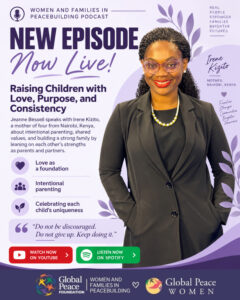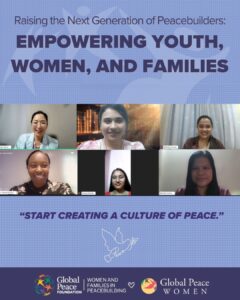

In S1E4 of Women and Families in Peacebuilding, host Jeanne Bessell speaks with Bambie Panta about the beauty and challenge of cross-cultural marriage, and how shared values, communication, and trust can help turn differences into a stronger family foundation.
Marriage is never built by two people who are exactly the same. Every couple brings different habits, expectations, family traditions, and ways of seeing the world. In a cross-cultural marriage, those differences can become more visible around religious holidays, family expectations, food traditions, gender roles, and daily moments that test patience and love.
For Bambie Panta, originally from the Philippines and now living in Nepal with her husband, marriage has been a journey of learning how to honor differences while staying deeply connected. Her story is not about a perfect marriage. It is about two people choosing, again and again, to understand each other while building a home across cultures, faith traditions, and household expectations.
Bambie grew up in a Catholic background, while her husband comes from a Hindu family in Nepal. With that came different festivals, customs, food traditions, and expectations about family life. Rather than seeing these differences as barriers, Bambie and her husband learned to make space for both worlds inside their home. They celebrate both traditions, honor both faith backgrounds, and allow their children to see that love can make room for more than one story.
That choice took effort. After moving into a new cultural setting, Bambie faced expectations familiar to many daughters-in-law in traditional families, from responsibilities toward in-laws to religious practices different from what she had known. Some expectations felt natural. Others required patience, adjustment, and support. When cultural restrictions or family duties became difficult, he stepped in and helped bridge expectations between her and his family.
Their differences also appeared in ordinary places, like cooking. Bambie preferred certain food prepared in a lighter or half-cooked style, while her husband preferred food fully cooked. What could have become a repeated conflict became a lesson in communication. Instead of treating his preference as a rejection of her effort, Bambie learned to understand where he was coming from. They talked, adjusted, and compromised.
That may sound simple, but many marriages are strengthened or weakened in exactly these small places: the tone used in a conversation, the willingness to listen, the ability to pause before reacting, and the humility to ask, “What does this mean to you?” rather than assuming the worst. Bambie’s story reminds us that harmony is not the absence of difference. Harmony is what happens when difference is handled with love.
As she shares in the conversation:
“Harmony… doesn’t mean agreement only. I believe it means learning to coexist with love and respect, compromising and also complementing each other’s strength… imperfection sometimes actually brings beauty as well because that’s where you can use your strength.”
That wisdom sits at the heart of the episode. Peace in marriage is not built through sameness. It is built through respect, patience, and the daily decision to protect the relationship more than the argument. Differences do not have to weaken a home when both people are willing to listen, learn, and grow.
One of the most powerful parts of Bambie’s story is how she and her husband moved beyond traditional gender roles in the home. In the context she describes, men are not always expected to take part in household chores. Her husband, especially as the youngest son in his family, grew up within those expectations. But in their own home, they chose a different path. He washes dishes, does laundry, hangs clothes, and helps clean rooms. This is partnership in action.
By sharing domestic responsibilities, Bambie and her husband are teaching their sons that a home is not maintained by one person alone. Their children are learning how to cook, clean, wash dishes, and take responsibility regardless of gender. In this way, the couple is not only managing their own marriage; they are shaping the values of the next generation. That is how family culture changes.
The episode also speaks to couples navigating faith differences. Bambie and her husband found ways to celebrate Hindu festivals and Christian traditions, including Christmas, as opportunities for family connection. In doing so, they gave their children a home where difference is not feared, but understood. This kind of marriage requires maturity, curiosity instead of judgment, and the courage to say, “This is how I grew up,” while also having the humility to hear, “This is how I grew up too.”
Bambie’s story is beautiful because it is practical. She does not pretend there is a perfect formula for marriage. There is no manual that prepares a couple for every cultural difference, family expectation, faith practice, or small irritation that appears in daily life. But there are choices: choose communication over silence, respect over resentment, compromise over control, and connection over conflict.
Through faith differences, cultural expectations, cooking preferences, household responsibilities, and parenting, Bambie and her husband have continued to find common ground. Their story is a reminder that family is not built by avoiding differences. It is built by walking through them together, with love strong enough to listen and trust strong enough to grow.
Watch S1E4: “Bridging Cultures with Shared Values” to hear Jeanne Bessell’s conversation with Bambie Panta on cross-cultural marriage, shared values, communication, and family life.