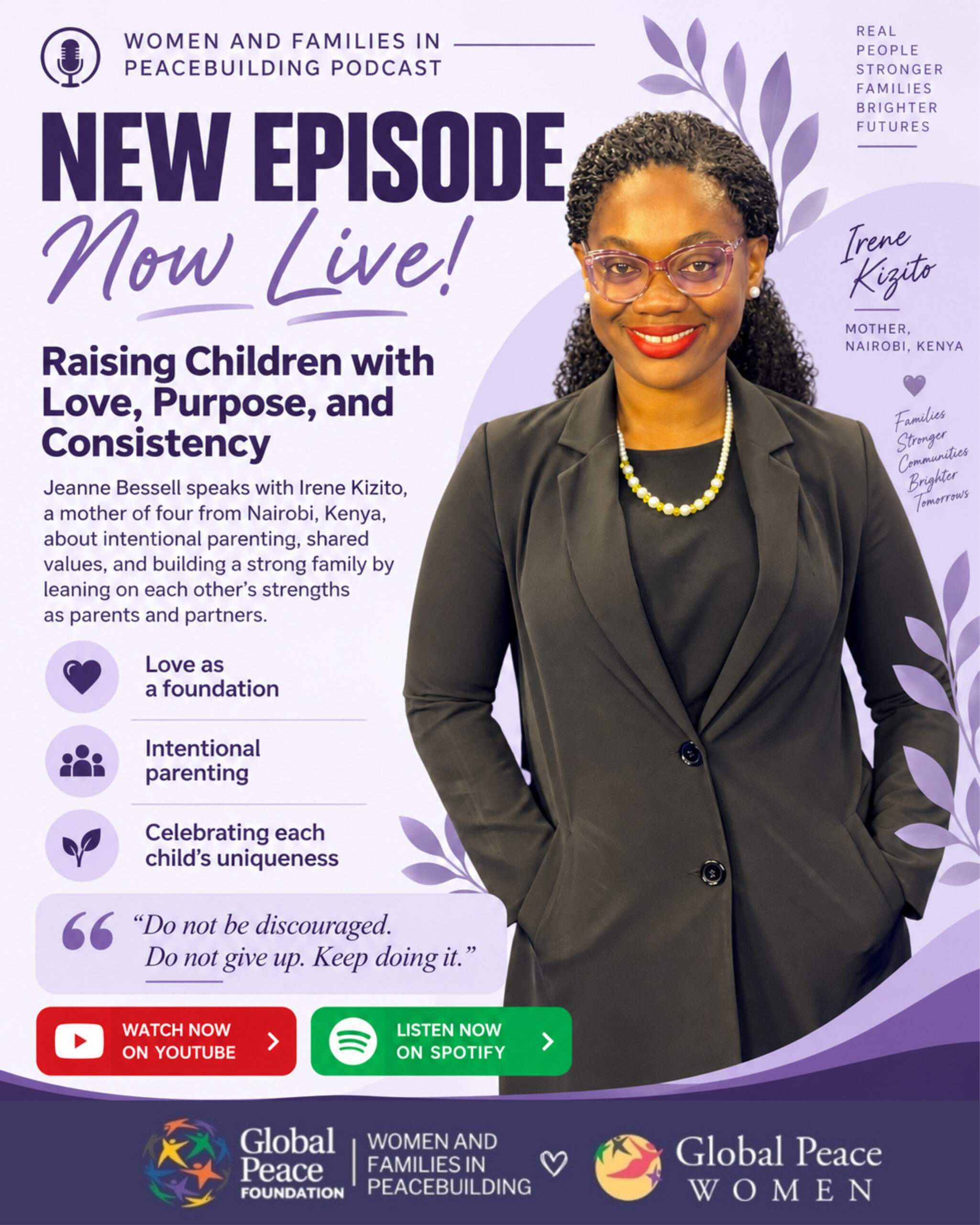
In this episode of Global Peace Women, host Jeanne Bessell speaks with Irene Kizito, a mother of four from Nairobi, Kenya, about intentional parenting, shared values, marriage, and raising children with love.
Family has a culture, shaped not only by what parents say, but by what children see every day: the tone used at home, how conflict is handled, how siblings treat one another, how love is expressed, and the quiet sacrifices parents make when no one is watching.
For Irene Kizito, parenting has been a journey of intention. As a mother of four, she and her husband did not want to raise their children by chance or simply follow expectations around them. They paused to ask a vital question: What kind of values do we want our children to carry into the world?
In her conversation with Jeanne Bessell, Irene shares how she and her husband grew together, as parents and partners. They discussed the values they wanted to build their home upon. They read, joined parenting courses, connected with support groups, and treated parenting as a responsibility worthy of learning and teamwork.
At the center of their home is one value above all: love. For Irene, love is not simply affection. It is the foundation from which other values grow. When children feel loved and accepted for who they are, they are not pressured to become copies of someone else. They are free to discover their strengths, personalities, and path. In that environment, respect, care, confidence, and responsibility can grow more naturally.
Children do not flourish when they are constantly compared. They flourish when they feel seen. They grow stronger when home is not a place where they must perform to be loved, but a place where they are guided, corrected, encouraged, and accepted. Irene’s way of teaching love is practical: hugging her children, affirming them when they help one another, and recognizing moments of kindness, learning, or care. These small gestures become part of a child’s inner language. Over time, children understand that love is not only spoken. It is practiced.
For Irene, teaching values is also about modeling. Children listen to words, but they study actions. They notice how parents treat one another, whether sacrifice is practiced or only preached, and whether respect is demanded from them but missing between adults. When Irene and her husband model care, sacrifice, and responsibility, their children begin to reflect those values with one another.
Irene also speaks honestly about the pressure to be perfect. She does not pretend that parenting is easy or that every day goes exactly as planned. Like many mothers, she has had to balance work, family, responsibility, and the desire to be present for her children. There are moments when she cannot monitor everything and moments when she may feel inadequate. But instead of chasing perfection, she focuses on consistency.
That distinction matters. Perfect parenting is impossible. Consistent love is possible. Perfect schedules may fail, but consistent values can remain. Parents may not be present for every moment, but when love, respect, and care are repeated often enough, those values stay with children. Irene’s honesty gives comfort to parents who wonder whether they are doing enough. Her message is that parents do not need to get everything right; they need to keep showing up with authenticity, humility, and purpose.
She also reminds us that each child is different. As a mother of four, Irene has learned that one approach does not work for every child. Each child has a different personality, strengths, and areas where they need more guidance. Some values may come easily to one child, while another may need more patience and support. Rather than forcing all her children into one mold, Irene tries to understand who each child is. She sees uniqueness as a gift to guide.
One of the most inspiring parts of Irene’s story is the partnership between her and her husband. Parenting, for them, is shared work. They have leaned on each other’s strengths, learned together, and made decisions together about the kind of home they wanted to build. When children see cooperation, respect, and shared responsibility, they learn what healthy partnership looks like.
Through Irene’s story, we see that raising children with values is not a single conversation. It is a daily rhythm. It happens in routines, sibling disagreements, shared meals, acts of service, school responsibilities, discipline, affection, apologies, encouragement, and the decision to keep trying after a difficult day.
Near the end of the conversation, Irene offers a simple but powerful encouragement: “Do not be discouraged. Do not give up. Keep doing it.” These words carry the heart of the episode. Parenting is not built in one perfect day. Character is not formed in one lesson. Family culture is formed through repetition, patience, love, correction, forgiveness, and the decision to keep going.
Irene’s story is a reminder that strong families are built with intention. Children need more than instruction; they need love. They need more than rules; they need example. They need more than provision; they need presence, affirmation, and guidance. Parents need grace too: permission to be human, courage to continue, communities that support them, and partners who walk with them.